Showing posts with label stock. Show all posts

Sunday, March 6, 2011

Vegan Minestrone

"Big Soup" or  "Minestrone",  prepared without meat or dairy.

Minestrone Soup in a Slow Cooker

We made vegetarian stock, and after straining out most of the stock for future use, we added a few fresh items to make meal-in-itself minestrone soup.  Several batches are shown in this photo set, no two the same.

What distinguishes "Vegetable Soup" from "Minestrone"?  Usually minestrone has a few beans and a few pieces of pasta in it, though not always, and vegetable soup can have those too.  Probably the biggest difference is whether you are having it in an Italian restaurant ... or in the kitchen of your Italian grandmother... or whether it is seasoned with oregano...

Here are some typical vegetables for a good potful of stock and minestrone:

Onion
Celery
Garlic
Carrot
Green pepper
Mushrooms

Tomato paste
Green peas
Parsley with stems

Dice and saute vegetables to bring out the flavor before adding tomato paste, peas, parsley,  and water.  Tomato paste (or puree, which is just tomato paste and water) are needed for richness, and mushrooms and peas are needed for the same reason. These foods are high in "umami", the subtle flavor that tells our senses that the food is satisfying. Fresh tomatoes, if wanted, can be added later.


Soup cooked earlier, with cabbage ready to be added.

Bring the soup to a boil, then lower heat and simmer until the vegetables are done.  Remove any portion of the broth that you want to save for use later as stock. Then add any, or all, of the following:

Cooked dry beans
Green beans
Kale
Cabbage
Brussels Sprouts
Parsley
Fresh tomato
Diced potato
Diced turnip
Diced rutabaga
Diced parsnip
Pasta*
Rice*
Seasonings

*Pasta and rice will continue to swell for as long as they are in water, so if you put them in the soup, eat it immediately.  Starches are better stored separately and then added to the soup just before serving.


Vegan Minestrone

At this point you have a hearty vegan soup.  Serve with crusty rolls or croutons.  If dairy is not an issue, the finishing touch is grated parmesan, to be spooned in at the table.  Or cheese toast, made from sharp cheddar and whole-grain bread, is the perfect accompaniment.

To see a full set of photographs showing how this dish was made, go to this set on flickr.   (It will open in a new tab or window; to return to this page, just close it.) The small pictures are thumbnails; click on each one to see it full-size, and to read the comments under it.  If you prefer to use the slideshow feature, you won't see the captions unless you click on "show info" (top right).

This recipe is #80 in Baker's Dozen Challenge Countdown

Sunday, February 13, 2011

Chicken Soup and Stock

This recipe for chicken soup is both simple and delicious.  I learned it years ago from my children's grandmother, who brought it with her from the Balkans.  She stressed that all ingredients must be fresh, not preserved, and that every one of the ingredients is there for a reason.  The stock it produces is versatile; it can be used in any cuisine.

Place into a slow cooker, dutch oven, or soup pot one of the following:

Whole young chicken - if buying a fryer for soup, choose the largest available.
Chicken parts, any combination, 3 pounds or more.
Roasted whole chicken or roasted chicken parts.
Bones, skin, cartilege, fat, etc. of chicken, raw or roasted, from which the meat has been removed.

Chicken scraps make excellent soup; just skim the fat at the end, and strain out all the little bits.  A few pounds of necks and backs will produce fine chicken stock! Dark meat makes better soup than white meat.  The one thing you don't want to use for soup is boneless skinless chicken, especially not boneless skinless white meat.

Chicken-soup-to-be: just add water and heat

Add to the pot the following fresh (not frozen, canned, or dried) ingredients:

1 large or 2 smaller onions
2-3 carrots
1-2 tomatoes
1-2 stalks celery
fresh parsley including stems
2-3 cloves garlic
1 tsp salt
sprinkle of pepper

Water to cover

No need to chop the vegetables.  When served they are more appealing whole.

Our recipe assumes 3-5 pounds of chicken; if less, decrease the seasoning vegetables and perhaps the size of the pot.  Too much water makes thin soup!  If more, increase pot size, seasonings, and water proportionately. A roasting or stewing chicken will require longer cooking.

Chicken soup with soup vegetables in a serving container

Heat at medium high until the soup comes to a boil, then reduce heat to simmer. Cook until chicken is well done but still holding together. (How long this takes will depend on the age and size and therefore, the tenderness of the chicken, and on the temperature at which it is cooked; anywhere from one to several hours.) Lift out the chicken and strain the soup.  Adjust seasonings.

Set aside a portion of the soup for stock and return the remaining broth to your (rinsed) pot.  Sort through the residue in your strainer, and return to the soup all pieces that are good for eating (carrots, onions, and whatever else you like) and throw the rest away.  Now your soup is ready for whatever additions you want to make - see recipes for chicken soup here or here or elsewhere.

To see a full set of photographs showing various ways that chicken stock can be made, go to this slide show on flickr.   (It will open in a new tab or window; to return to this page, just close it.)  No need to read the captions as they are borrowed from various other sets.


Chicken Soup with Rice

In December I will be
A baubled, bangled Christmas tree
With soup bowls draped all over me
Merry once, merry twice
Merry chicken soup with rice
I told you once, I told you twice
All seasons of the year are nice
For eating chicken soup with rice
-- Maurice Sendak

Saturday, February 5, 2011

Chicken Soup I

Use only fresh, not frozen, canned, or dried:

Whole young chicken*

1 large or 2 smaller onions
2-3 carrots
1-2 tomatoes
1-2 stalks celery
fresh parsley including stems
2-3 cloves garlic

1 tsp salt
sprinkle of pepper

Water to cover generously

Place all in a large pot or kettle

Heat at medium until it comes to a boil, then reduce heat to simmer. Cook until chicken is well done but still holding together.  Lift out the chicken and strain the soup.  Return carrots and onion to the soup (and other seasoning vegetables if wanted) and throw the scraps away.  Adjust seasonings.  Serve with potatoes, noodles, rice, dumplings, or matzo balls.

*If using a fryer, look for the largest available. A roaster requires longer cooking.  How much of the seasoning vegetables to use, and how much water, will depend upon the size of your bird, and upon the size of the vegetables.  How long to cook also depends upon those variables.  Too much water or too little cooking produces thin soup!


This is a photo set, showing thumbnails.  Click on one after another to view large and to read captions.

Monday, January 31, 2011

Vegetarian stock

I don't know whether it helps or hurts that I don't much like vegetarian broth - no brand or form of it canned is even edible, so far as I am concerned.  Ugh, what do they put in it?  So  I am trying to make it from scratch.  We've had several batches, all different, all okay, none perfect, but we're getting closer.

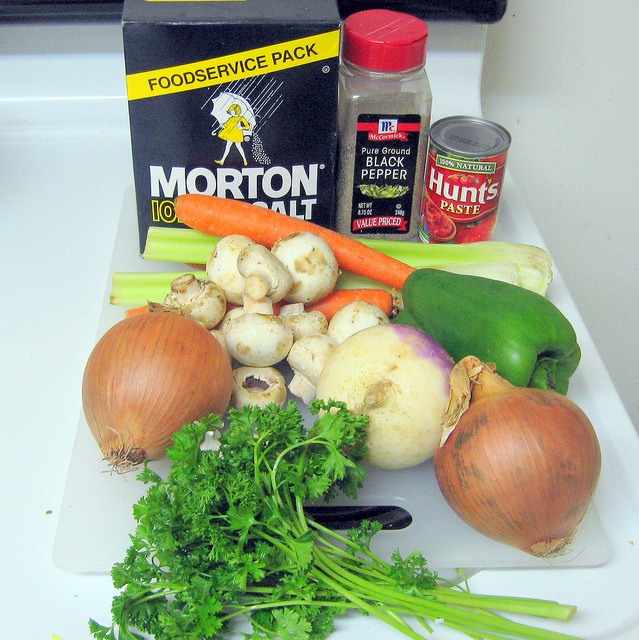
Ingredients.  We decided against the turnip.

One rule: don't overcook, because most overcooked vegetables, even seasoning vegetables, taste sour and awful. (There are exceptions; some green vegetables develop a different and much better taste after being cooked for an hour or more.)

Another rule, as I am learning, is that what meat contributes to good stock is an abundance of the flavor called "umami", a Japanese word meaning "deliciousness", which in its pure form is found in monosodium glutamate.  If a veggie stock is going to satisfy, umami must be included from vegetable sources.  Ingredients high in glutamates include ripe tomatoes and mushrooms, especially dried shiitake mushrooms.  Also high in glutamates are potatoes, sweet potatoes, carrots, and peas. Thus, veggie stock will be more satisfying if it contains, at least, tomato paste, mushrooms, carrots and peas.  The more of those other ingredients included in the soup,  the more satisfying the broth will be.  With glutamate- rich foods as a base and liberal inclusion of the standard seasoning vegetables, we can produce a stock both satisfying and tasty.

Start with this:

Onion
Celery
Garlic
Carrot
Green pepper
Mushrooms

Dice and saute vegetables in batches to bring out the flavor, and when softened, place them in a cooking vessel (stockpot, crockpot, microwave- safe container, hotpot) about twice the volume of the vegetables you've sauteed.

Seasoning Vegetables


Then add:

Tomato paste
Green peas
Parsley with stems
Salt if wanted

Fill pot 3/4 with water

Cook on High until hot, then reduce to Low and cook until vegetables are just done.

Strain out as much of the broth as you want to reserve, leaving enough broth with the cooked vegetables so that with the addition of some fresh items you can serve it as Vegetable or Minestrone soup.

One pint of stock will fill a 16-cube ice tray,  giving you frozen stock measured roughly in ounces for use in quick "little soups" or in other dishes.

Vegetarian Broth

Note:  Other ingredients to consider for veggie stock are "kombu", a seaweed used in Japanese cuisine, soy sauce, and Chinese cabbage.  All these will undoubtedly increase the "deliciousness" of your stock, but whether the flavors are appropriate will depend on what you intend to do with the stock.

To see a full set of photographs showing how this dish was made, go to this set on flickr.   (It will open in a new tab or window; to return to this page, just close it.) The small pictures are thumbnails; click on each one to see it full-size, and to read the comments under it.  If you prefer to use the slideshow feature, you won't see the captions unless you click on "show info" (top right).