Showing posts with label vegetarian. Show all posts

Tuesday, February 22, 2011

Two-Bean Salad

A Russian-style layered salad filled with substantial
stick-to-the-ribs ingredients.

Two-bean Salad with chopped egg

We collected these ingredients:

Black beans
Sweet peas
Carrot
Celery
Tomato
Green onion
Spinach leaves
Lemon juice
Hard-boiled egg

Then we layered them:

Start with spinach leaves in a small bowl.

Add ingredients; do not stir.  We did it in this order:

Spinach
Black Beans
Diced celery
Diced tomato (salt and pepper the tomato layer)
Canned sweet peas
Mayonnaise, spread across the peas
Diced carrot
Diced green onion
Diced egg
Lemon juice
... and vegetable oil drizzled around the top.

Refrigerate for a time.

Garnish with lemon slices and the last bit of green onion

To see a full set of photographs showing how this dish was made, go to this set on flickr.   (It will open in a new tab or window; to return to this page, just close it.) The small pictures are thumbnails; click on each one to see it full-size, and to read the comments under it.  If you prefer to use the slideshow feature, you won't see the captions unless you click on "show info" (top right).

This recipe is #88 in the Baker's Dozen Challenge Countdown.

Dinner Salad with Potatoes

I learned to make this salad from my children's grandmother, who grew up in the Balkans. She liked to use endive for salad greens. Here I've used romaine lettuce. Dressed with oil and lemon juice it needs no other salad dressing.


Into a small bowl put:

3 cups of still-warm cooked potatoes,  peeled and sliced or diced.
1/2 cup diced onion
Juice of one lemon
Salt and pepper to taste
Drizzle olive oil over all

Mix gently, then set in refrigerator to cool and to marinate
for an hour or more.

Begin with a bed of salad greens. Mound the potatoes at the center.
Add cheese (I used sharp cheddar and swiss) and tomatoes. Garnish
with bell pepper slices and red onion slices. Voila!

To see a full set of photographs showing how this dish was made, go to this set on flickr.   (It will open in a new tab or window; to return to this page, just close it.) The small pictures are thumbnails; click on each one to see it full-size, and to read the comments under it.  If you prefer to use the slideshow feature, you won't see the captions unless you click on "show info" (top right).

This recipe is #89 in the Baker's Dozen Challenge Countdown.

Saturday, February 19, 2011

Easy Hummus

Hummus made from chickpeas, olive oil, lemon juice, and garlic

2 cups garbanzo beans (chickpeas)
2 Tb olive oil
2 cloves garlic, smashed
1 tsp salt or to taste
Juice of 1 lemon

Other ingredients can be added: tahini, sesame oil, roasted red pepper, cayenne pepper, to name a few.

Squeeze in the lemon juice and turn on the blender or food processor.
 Stop when it is smooth and fluffy like a dip.   ...OR... my household actually likes lumpy hummus. Sometimes we put the ingredients into a shallow bowl and mash it up with the back of a fork, leaving visible bits of bean.
 
Spoon hummus into the center of a plate. Sprinkle with paprika, and make a well in the center in which to pour a spoonful of olive oil.

Add crackers or pita and some salad ingredients.

To see a full set of photographs showing how this dish was made, go to this set on flickr.   (It will open in a new tab or window; to return to this page, just close it.) The small pictures are thumbnails; click on each one to see it full-size, and to read the comments under it.  If you prefer to use the slideshow feature, you won't see the captions unless you click on "show info" (top right).

This dish is #92 in the Baker's Dozen Challenge Countdown!

Sunday, February 13, 2011

Pasta Primavera

Start with "soffritto" which is celery, carrot, and onion in about equal amounts diced and sauteed in olive oil. Garlic and other flavorings may be added if wanted.

1/4 cup olive oil
3 cloves garlic

Heat thin-sliced garlic slowly in oil until it begins to darken. Then add:

1/2 c. diced carrot
1/2 c. diced celery
1/2 c. diced onion

note: experiment, but in the end you may decide to go heavy on the onion and light on the celery. Celery can be very dominant.

When the soffritto is well softened, lift it out of the pan to a holding dish, allowing the oil to drip back into the pan.


Prepare Vegetables

Any vegetable can be used in pasta primavera though colorful Spring vegetables are more usual. ("Primavera" means springtime.)

Carrots, zucchini, yellow squash, and red onion slices


Cut vegetables in a shape to reflect the shape of the pasta you plan to use. Because on this occasion my pasta is spaghetti, I cut the vegetables in longish strips. For vegetables I used what I had on hand: yellow summer squash, zucchini, carrot, and red onion.

Turn up the heat to medium-high, wait for the pan to get hot, and add 
the vegetable strips. Allow it to cook unstirred for 3-4 minutes,
then turn with a spatula and give it a couple of minutes more. Fast hot cooking gets the veggies done while leaving them colorful and crisp.  If you have starchy pasta water nearby, toss in a quarter cup of it to 
stop the cooking (it will all boil off quickly) and to give a sheen to 
the vegetables.

Toss soffritto with your pasta, in the frying pan if pasta has become cold.

Slide the spaghetti into a plate or bowl and top with a generous amount of vegetables and some Parmesan cheese.

Pasta Primavera with gluten-free rice spaghetti


To see a full set of photographs showing how this dish was made, go to this set on flickr.   (It will open in a new tab or window; to return to this page, just close it.) The small pictures are thumbnails; click on each one to see it full-size, and to read the comments under it.  If you prefer to use the slideshow feature, you won't see the captions unless you click on "show info" (top right).

This dish is #97 on the Baker's Dozen Challenge Countdown.

Monday, January 31, 2011

Vegetarian stock

I don't know whether it helps or hurts that I don't much like vegetarian broth - no brand or form of it canned is even edible, so far as I am concerned.  Ugh, what do they put in it?  So  I am trying to make it from scratch.  We've had several batches, all different, all okay, none perfect, but we're getting closer.

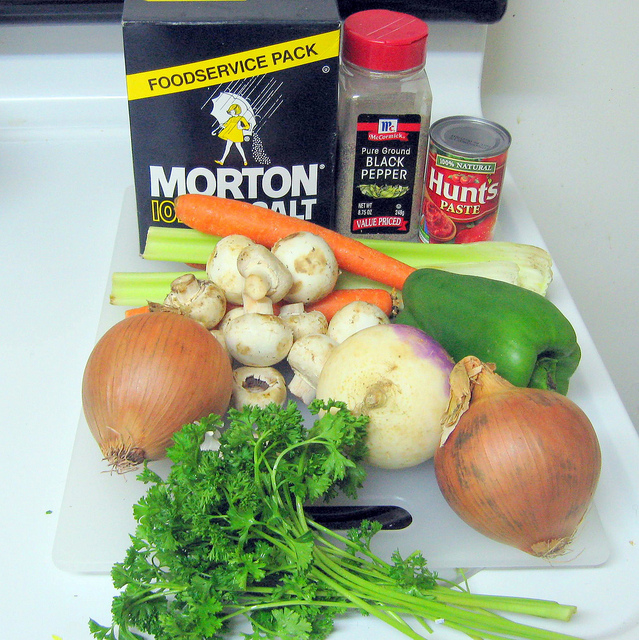
Ingredients.  We decided against the turnip.

One rule: don't overcook, because most overcooked vegetables, even seasoning vegetables, taste sour and awful. (There are exceptions; some green vegetables develop a different and much better taste after being cooked for an hour or more.)

Another rule, as I am learning, is that what meat contributes to good stock is an abundance of the flavor called "umami", a Japanese word meaning "deliciousness", which in its pure form is found in monosodium glutamate.  If a veggie stock is going to satisfy, umami must be included from vegetable sources.  Ingredients high in glutamates include ripe tomatoes and mushrooms, especially dried shiitake mushrooms.  Also high in glutamates are potatoes, sweet potatoes, carrots, and peas. Thus, veggie stock will be more satisfying if it contains, at least, tomato paste, mushrooms, carrots and peas.  The more of those other ingredients included in the soup,  the more satisfying the broth will be.  With glutamate- rich foods as a base and liberal inclusion of the standard seasoning vegetables, we can produce a stock both satisfying and tasty.

Start with this:

Onion
Celery
Garlic
Carrot
Green pepper
Mushrooms

Dice and saute vegetables in batches to bring out the flavor, and when softened, place them in a cooking vessel (stockpot, crockpot, microwave- safe container, hotpot) about twice the volume of the vegetables you've sauteed.

Seasoning Vegetables


Then add:

Tomato paste
Green peas
Parsley with stems
Salt if wanted

Fill pot 3/4 with water

Cook on High until hot, then reduce to Low and cook until vegetables are just done.

Strain out as much of the broth as you want to reserve, leaving enough broth with the cooked vegetables so that with the addition of some fresh items you can serve it as Vegetable or Minestrone soup.

One pint of stock will fill a 16-cube ice tray,  giving you frozen stock measured roughly in ounces for use in quick "little soups" or in other dishes.

Vegetarian Broth

Note:  Other ingredients to consider for veggie stock are "kombu", a seaweed used in Japanese cuisine, soy sauce, and Chinese cabbage.  All these will undoubtedly increase the "deliciousness" of your stock, but whether the flavors are appropriate will depend on what you intend to do with the stock.

To see a full set of photographs showing how this dish was made, go to this set on flickr.   (It will open in a new tab or window; to return to this page, just close it.) The small pictures are thumbnails; click on each one to see it full-size, and to read the comments under it.  If you prefer to use the slideshow feature, you won't see the captions unless you click on "show info" (top right).